Mold Removal in Las Vegas, NV
The city of Las Vegas proper is the older northern half of the valley, and the neighborhoods closest to Henderson are the ones along Boulder Highway and east of the airport that went up from the 1950s through the 1980s. Those houses are smaller than the Henderson tracts, more often on a raised slab with a rooftop evaporative cooler, and more likely to have original copper or galvanized lines under the slab. Newer subdivisions in the southeast and southwest of the city are the same stucco-and-tile pattern as Henderson.
Mold in a Las Vegas house follows the same rule as everywhere in the valley: it needs a leak. A swamp cooler pan, a slab line, a water heater, or a roof that let a July storm through is where the crew looks first, because the outdoor air here spends most of the year too dry to grow anything.
Homeowners in Las Vegas reach an independent local mold provider through this site's phone line. That provider meters the house and tells you what it needs. We only set up the call.
Las Vegas mold removal in a 1970s ranch and a 2000s two-story
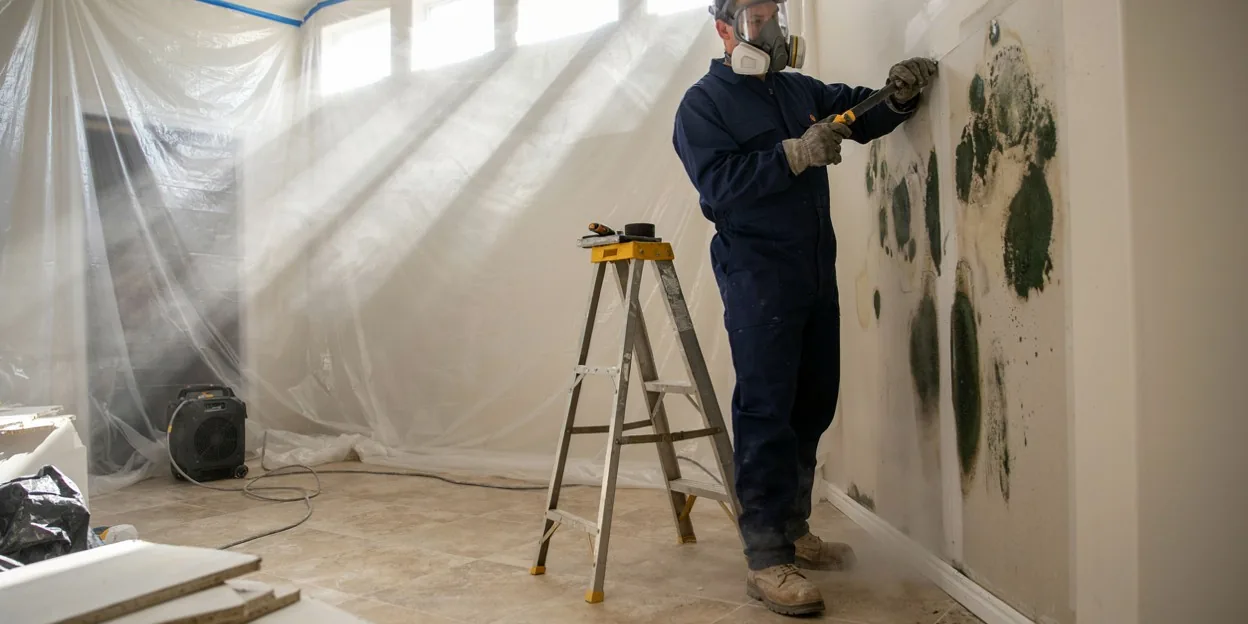
A dark patch behind the washer in a Boulder Highway ranch is black mold removal, handled by extent rather than color. A rooftop cooler that soaked the sheathing is attic mold remediation. A hall floor that lifted after a slab leak in a newer two-story is mold removal, with the laminate and pad out before anything dries.
The health district and the wash that carries the valley's water away
The Southern Nevada Health District is the agency a tenant calls about a landlord who will not fix a leak, and its environmental health office covers the whole county. Every drop of treated indoor water in the valley leaves through the Las Vegas Wash, which the Las Vegas Wash Coordination Committee manages on its way to Lake Mead past the east edge of Henderson.
Call (702) 602-8512 and tell us what you see. We put you through to a local mold provider serving Las Vegas.
Services Available in Las Vegas
Mold Removal
Growth on drywall behind a water heater, a fridge line, or a slab leak: room sealed, wet board cut to the meter line, framing HEPA-cleaned and dried.
Black Mold Removal
A dark patch handled by how far the water traveled, not its color: containment, porous material out, hard surfaces cleaned, leak fixed before closing.
Whole-Home Mold Remediation
A slab leak or a supply line that ran for weeks while the house sat empty, mapped room by room and cleared in zones as one project.
HVAC Mold Cleaning
Coil, drain pan, and condensate line cleaned or replaced when the air handler in the garage or attic sweats through a 110-degree summer.
Bathroom Mold Removal
Growth behind a vanity, under a shower pan, or on a ceiling with no fan, removed with the supply line or drain leak fixed first.
Attic Mold Remediation
Growth on roof sheathing under slipped tile or around a sweating duct, cleaned and treated once the underlayment or the insulation is fixed.
Mold Odor Removal
A musty smell in a house that looks fine, traced to the wet material under the laminate or behind the cabinet, then removed and treated.
Mold Damage Repair
Drywall, texture, baseboard, and cabinet bottoms put back after removal, once the slab reads dry and the leak that started it is repaired.